FOR GROCERY RETAILERS
The model that moves shelf-life performance beyond best guess and
into a process you can actively manage.
Your shoppers expect produce that stays fresh at home. But you inherit a journey you didn't control and may not fully see.
Chorus is at the core of the Stack, introducing Layer 4 active protection and strengthening automation and visibility to make true predictability possible.
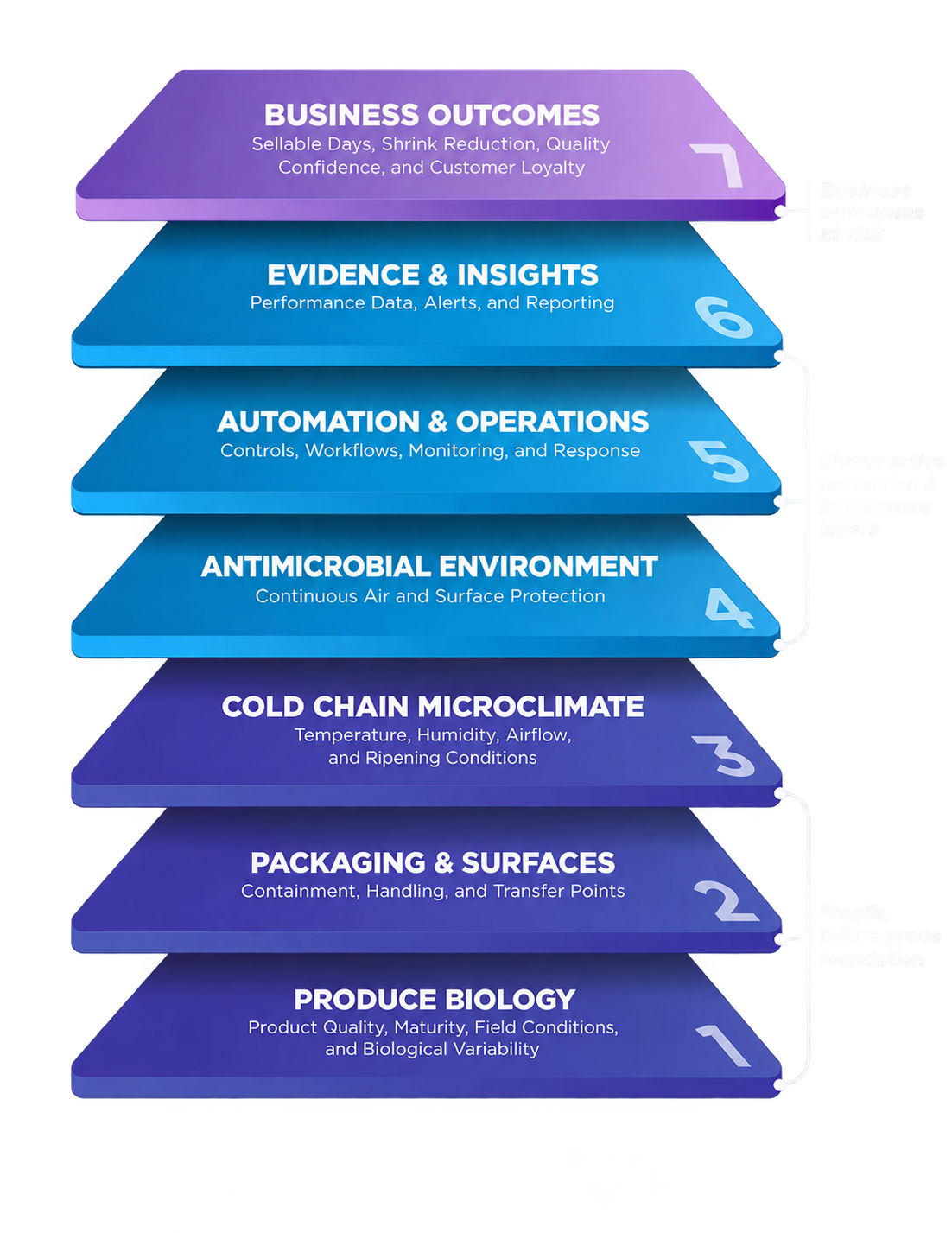
Chorus Shelf-Life Stack™
THE JOURNEY BEFORE ARRIVAL
You inherit the variability.
Not always the visibility.
Fresh produce arrives with a history.
Field conditions, harvest maturity, packaging, handling, transit, dwell time, temperature, humidity, airflow, and every handoff along the way can influence the condition of product before it ever reaches your operation.
You cannot undo that history. And you may not have complete visibility into everything that happened along the way.
That makes one of the most important questions in fresh produce surprisingly difficult to answer:
How much usable selling time do you actually have left?
A fresh appearance does not tell you the whole journey.
The challenge is making inventory and quality decisions when the product in front of you may carry the effects of upstream conditions you could neither control nor fully observe.
Field & Harvest
Starting quality and maturity
Pack & Handling
Packaging, handling, and transfer points
Store & Transport
Time and changing conditions
Receive & Manage
Decisions with an incomplete history
Layers
1-3
THE FRAGILE FOUNDATION
Understand what you inherit.
Layers 1–3 of Chorus' Shelf-Life Stack™ describe the biological, physical, and environmental conditions that shape fresh produce before downstream controls can be applied.
Each layer matters on its own. More importantly, variability can accumulate across all three.
LAYER 1
Produce Biology
Starting quality, maturity, field conditions, varietal differences, and natural biological variability give every shipment a different starting point.
LAYER 2
Packaging & Surfaces
Packaging, handling, contact surfaces, and transfer points shape the conditions produce encounters as it moves through the supply chain.
LAYER 3
Cold Chain Microclimate
Temperature, humidity, airflow, ripening conditions, loading, dwell time, and movement between environments continue shaping product condition through storage and transit.
By the time produce reaches retail, the starting point for the remaining shelf-life window is rarely uniform.
Layers
4-6
ACTIVE PROTECTION, CONTROL & VISIBILITY
Act on the conditions you can manage.
You cannot change a shipment’s past. You can reduce the impact of upstream failure points once product reaches the store.
That requires something the shelf-life equation has historically lacked: active protection. Chorus introduces that capability at Layer 4, while strengthening Layers 5 and 6 with greater automation, control, and visibility.
LAYER 4
Antimicrobial
Environment
Continuously manage microbial pressure in the environment surrounding fresh product.
LAYER 5
Automation &
Operations
Strengthen day-to-day control by connecting sensing, automated response, and system operation.
LAYER 6
Evidence &
Insights
Enhance visibility through monitoring, alerts, and reporting on conditions, performance, and response over time.
Continuous risk requires continuous control.
Layer
7
BUSINESS OUTCOMES
Connect control to the results that matter.
The goal of the Shelf-Life Stack™ is better, more predictable fresh performance.
For grocery retailers, that means creating more opportunity to sell through inventory, protect product quality, and deliver the freshness shoppers expect.
GROCERY STORES
To achieve optimal Layer 7 business outcomes, a more methodical approach to fresh performance is required. The Shelf-Life Stack™ is the key.
- Shrink reduction
- Sellable days
- Quality confidence
- Customer loyalty
THE GROCERY BUSINESS CASE
Fresh performance reaches beyond the shelf.
Fresh produce performance affects more than what gets marked down or discarded. It influences inventory economics, the customer experience, and how shoppers judge the broader store.
5.6%
Average supermarket produce shrink¹
35%
of consumers reported switching stores primarily because of dissatisfaction with fresh-product quality²
42%
of consumers said they are more likely to buy additional packaged items when purchasing fresh or prepared foods²
94%
of surveyed grocers said fresh and prepared foods play a significant role in driving customer loyalty²
Sources: ¹ International Fresh Produce Association, The Produce Industry 2025. ² McKinsey & Company, The State of Grocery North America 2026.
EXPLORE THE THINKING
Go deeper into the Shelf-Life Stack™
The Shelf-Life Stack™ was created to help the fresh produce industry see shelf life as an interconnected system. Our ongoing series explores the variability retailers inherit, the controls available downstream, and the business implications of fresh performance.

Introducing Chorus' Shelf-Life Stack™
A New Model to Rethink Fresh Produce Shelf Life as a Whole System
Explore the seven-layer framework and why shelf life predictability depends on understanding the full system surrounding fresh product.
The Fragile Foundation of the Shelf-Life Stack™
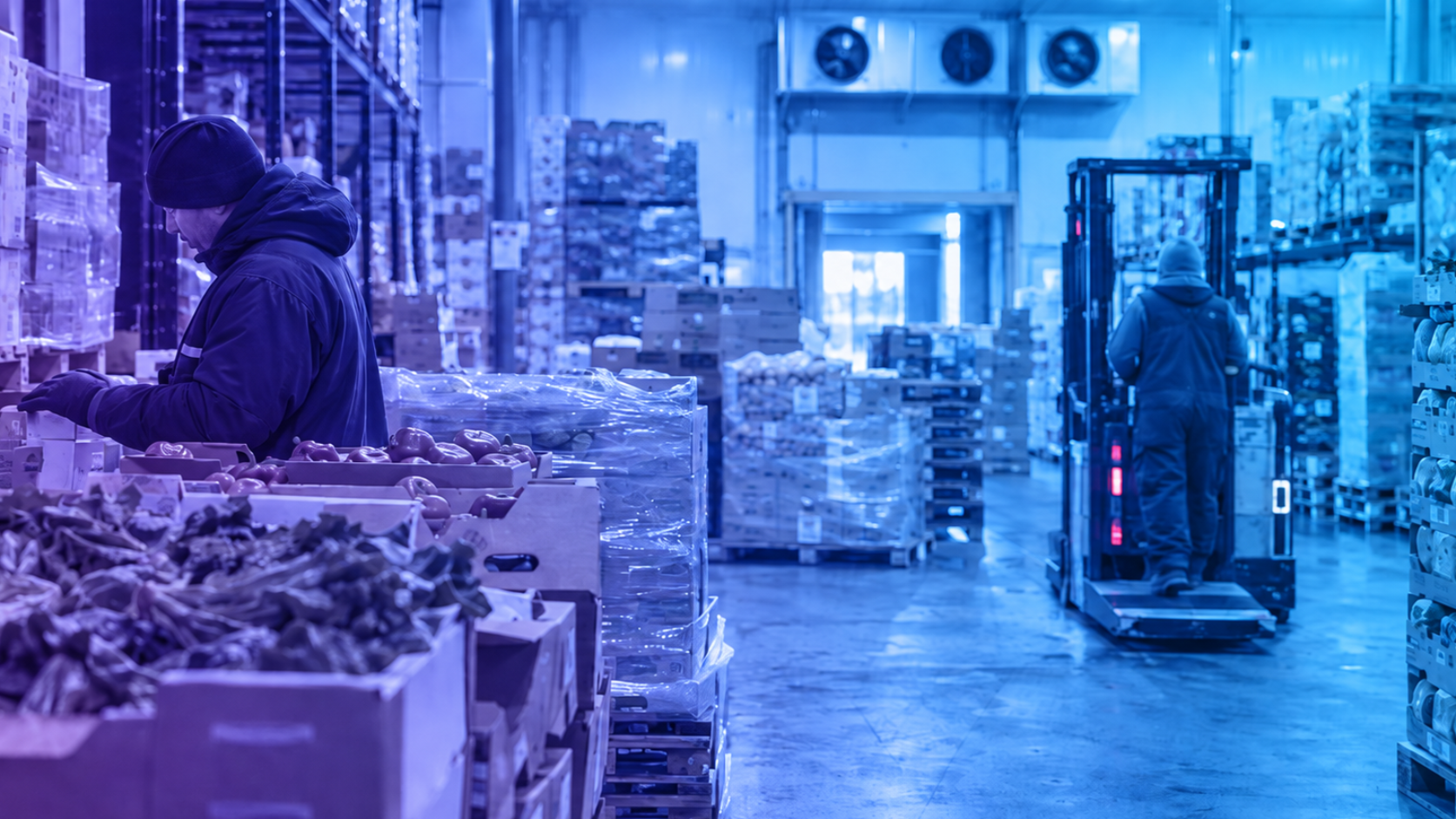
Why Produce Shrink Starts Upstream
Explore how biological variability, packaging and handling, and cold-chain conditions can accumulate before fresh product ever reaches the retailer.
More Shelf-Life Stack™ insights coming soon.
Take Control of Shelf-Life Performance
The Shelf-Life Stack™ shows what it takes to make true shelf-life predictability a reality.
Discover how Chorus closes the gap between prediction and control through continuous antimicrobial protection, closed-loop sensing and response, and real-time performance visibility.