The Fragile Foundation of the Shelf-Life Stack™
Why Produce Shrink Starts Upstream

Produce shrink and inconsistent quality rarely begin at the shelf.
By the time fresh product reaches a retailer’s backroom or display, some of its remaining sellable life may already have been lost through biological variability, handling, transfer points, and fluctuations across the cold chain. Retailers do not start with a blank slate. They inherit the cumulative effects of everything that happened upstream.
That inheritance matters because produce shrink remains a material retail challenge. According to the International Fresh Produce Association, average supermarket produce shrink was 5.6% for the calendar year ending September 29, 2024.
The instinct is often to look for a single failure point. Where did temperature drift? Where did handling break down? Where was the product held too long?
Sometimes there is a clear answer. More often, the loss is cumulative.
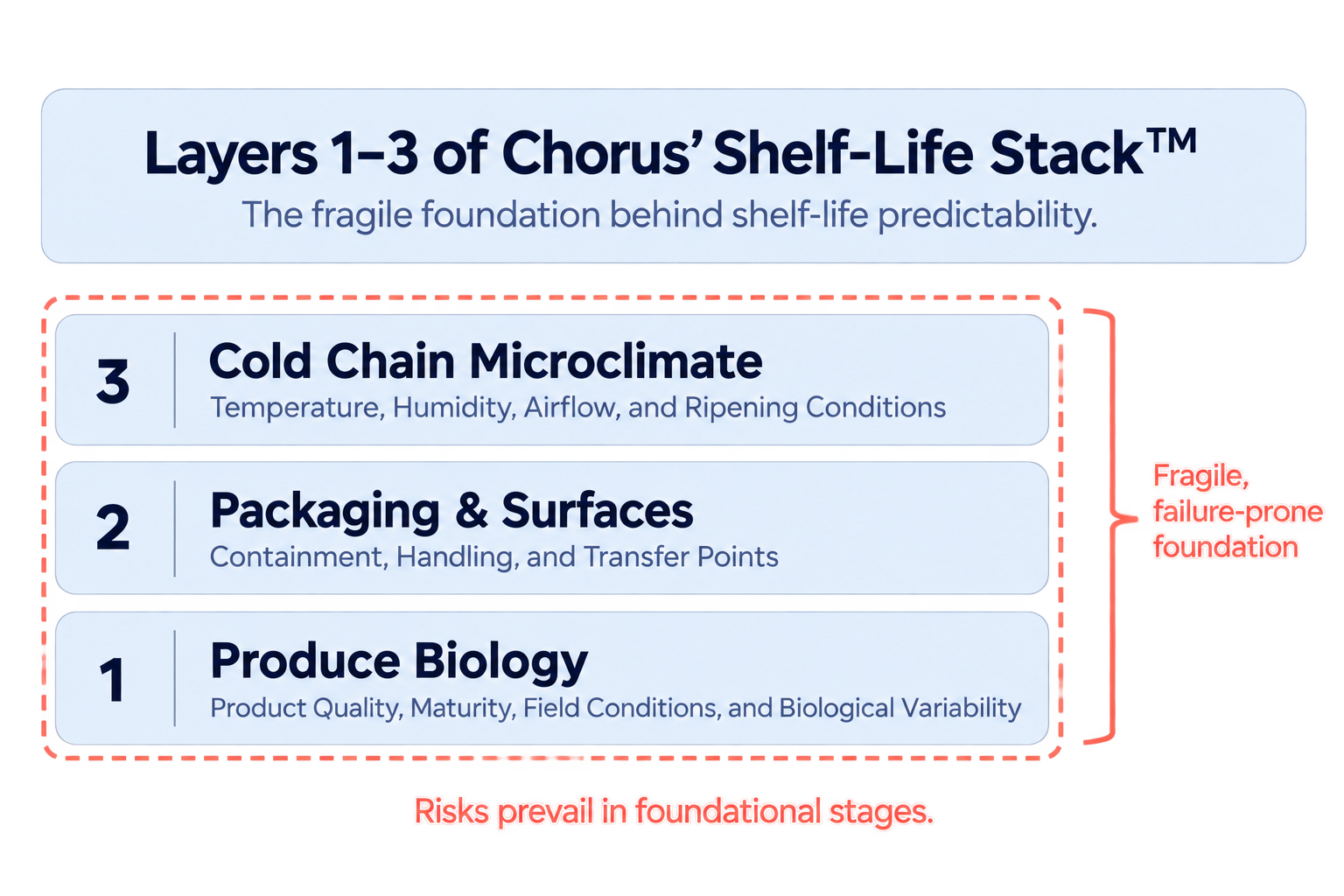
Chorus’ Shelf-Life Stack™ provides a new model to understand that problem. By looking at shelf life as a whole system, the framework brings the vulnerabilities of the first three layers into focus: Produce Biology, Packaging & Surfaces, and Cold Chain Microclimate. These layers form the foundation of fresh produce shelf life. They are essential, highly variable, and distributed across a supply chain that is difficult to manage perfectly at every handoff.
Retailers inherit the consequences
Every piece of produce arrives with a history.
Long before it reaches a store, its remaining sellable life has been influenced by field conditions, harvest maturity, handling, packaging, storage, transit, dwell time, temperature, humidity, and airflow.
Retailers may only see the final manifestation of those conditions. A product softens sooner than expected. Visible deterioration appears. Quality becomes inconsistent across shipments. Inventory that was expected to remain sellable for several more days has to be pulled early.
The loss becomes visible at retail even when the conditions that contributed to it began much earlier.
That is one of the central realities captured by Chorus’ Shelf-Life Stack™: retailers inherit the consequences of upstream variability.
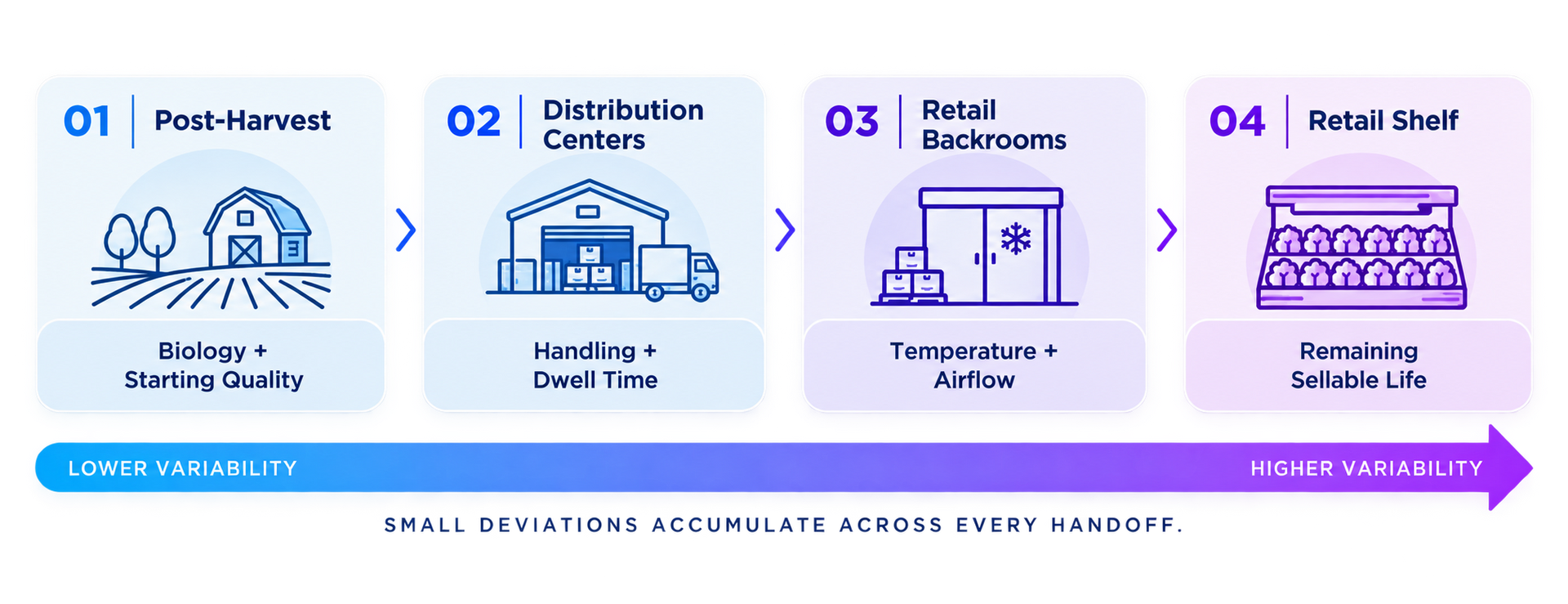
And every additional handoff creates another opportunity for small deviations to accumulate.
Layer 1: Produce Biology
Variability begins before any operational control is applied.
Fresh produce is biologically variable by nature. Starting quality, maturity at harvest, field conditions, commodity characteristics, and varietal differences all influence shelf-life potential.
Two shipments of the same commodity can enter the supply chain with different starting points. Even within the same shipment, individual products may not age at exactly the same rate.
That biological variability shapes what comes next.
Cold storage, packaging, and handling practices can help preserve quality, but they cannot reset the biological clock. The product enters the supply chain with a finite amount of potential sellable life, and that starting point is never perfectly uniform.
This is one reason shelf-life predictability is difficult from the beginning. The industry is managing a product whose condition is inherently dynamic.
Layer 2: Packaging & Surfaces
The second layer adds operational exposure.
Packaging is critical to fresh produce protection but produce moves through a long sequence of real-world interactions. It is packed, staged, transported, unloaded, handled, transferred, stored, and displayed.
Every handoff introduces another set of conditions.
Packaging integrity can vary. Dwell times change. Products move between environments. Surfaces and equipment create additional contact points. Handling practices differ across facilities, shifts, and operators.
Packaging and handling controls remain indispensable. The challenge is consistency.
A system that depends on many people, facilities, transfer points, and operating conditions will always contain some degree of variability. Chorus’ Shelf-Life Stack™ places those variables inside the same shelf-life equation so their cumulative effect is easier to understand.
Layer 3: Cold Chain Microclimate
The cold chain is one of the most important controls in fresh produce management and one of the most difficult to execute perfectly from end to end.
Temperature is only part of the picture. Humidity, airflow, ripening conditions, room loading, dwell time, and movement between environments all influence the microclimate surrounding fresh product.
Recent scientific literature reinforces that complexity. A 2025 review in Food Research International examined the interacting challenges of postharvest cold storage and the growing role of sensor-based and smart technologies in managing those environments. Separate 2025 research in Food Chemistry identified relative humidity as a material factor affecting water loss and postharvest quality.
Retailers and supply-chain operators are managing these variables across transit, distribution centers, staging areas, backrooms, and storage rooms. Maintaining ideal conditions continuously through every one of those environments is operationally demanding.
The broader retail environment adds another layer of difficulty. In McKinsey’s State of Grocery in North America 2026, grocers cited cost pressure, labor availability, and supply-chain complexity among the major barriers to scaling consistent fresh quality.
The cold chain matters enormously. The challenge is maintaining every variable at the right level across every handoff.
In practice, that is an extremely high bar.
Small losses compound
Shelf-life loss does not require one catastrophic breakdown.
A slightly weaker biological starting point can meet a longer dwell time. A small temperature excursion can be followed by suboptimal airflow. Handling can add further stress. Humidity can shift again downstream.
Each event may appear manageable on its own.
Together, they can chip away at remaining sellable life.
That is what makes the problem so difficult to diagnose. By the time quality deterioration becomes visible, some of the selling time may already be gone.
And once that time is lost, the retailer has fewer options.
The product may need to move faster. Markdown pressure can increase. Labor is spent inspecting, rotating, and pulling inventory. Eventually, the loss shows up as shrink.
Why passive controls cannot guarantee predictability
Layers 1–3 are essential. Fresh produce depends on strong biological starting conditions, appropriate packaging and handling, and disciplined cold-chain management.
But those foundational controls alone cannot guarantee shelf-life predictability.
The variables they manage are dynamic. They are distributed across multiple organizations and environments. They change over time. Many are already outside the retailer’s direct control by the time the product arrives.
Viewed through Chorus’ Shelf-Life Stack™, that limitation becomes clear. The foundational layers are critical, but their inherent variability makes perfect predictability unrealistic.
Better execution can reduce variability and improve consistency. It cannot make biology, handoffs, operating conditions, and cold-chain microclimates perfectly uniform across the full fresh supply chain.
A more predictable shelf-life model has to account for that reality.
Strengthening the Stack downstream
Chorus’ Shelf-Life Stack™ identifies Layers 4–6 as the opportunity to add more active protection and intelligence around a foundation that will never be perfectly uniform. These layers bring microbial management, automation, and evidence-based visibility into the broader shelf-life equation.
This is where Digital Microbial Control begins to enter the picture.
Digital Microbial Control introduces a more active, automated, and measurable approach to microbial management downstream. It is intended to complement the foundational controls by strengthening the later layers of the system, where retailers have another opportunity to influence what happens next.
The central point is clear:
Retailers inherit upstream variability, and small losses across the first three layers can compound before they ever have a chance to intervene.
Greater shelf-life predictability starts with acknowledging that the foundation will never be perfectly uniform, then building a stronger system around it.