Introducing Chorus’ Shelf-Life Stack™
A New Model to Rethink Fresh Produce Shelf Life as a Whole System
Fresh produce shrink is often treated as a problem that shows up at the shelf. A product loses quality, becomes unsellable, and is removed from inventory. The financial impact is visible there, but the conditions that contributed to that loss may have begun much earlier.
Freshness may be judged at the shelf, but shelf life is shaped long before product gets there. Biology, packaging, handling, temperature, humidity, airflow, microbial pressure, and operational response all influence how much sellable life remains. Fresh produce shelf life is the outcome of an interconnected system.
The stakes are significant. According to FMI's The State of Fresh Foods 2025, fresh foods accounted for 42% of total grocery sales in 2024, with produce alone representing 11% of total store sales. Fresh is a meaningful part of the grocery business.
It also plays an important role in how shoppers judge a store. The International Fresh Produce Association reports that 78% of Americans choose a grocery store based on the freshness of its produce.
When quality becomes inconsistent or sellable life is lost, the effects can extend beyond the individual product. Margin pressure increases. Operations become more difficult to manage. The customer experience becomes less consistent.
Shelf life is a system
Shelf life is shaped continuously throughout the produce journey.
A strawberry may begin with strong biological potential, but that potential can be affected by harvest maturity, packaging, handling, temperature fluctuations, storage conditions, microbial pressure, and the way each environment is managed along the way.
Each factor matters. More importantly, they interact.
A strong cold chain cannot change the biology of the product entering it. Packaging provides important protection, yet variability still exists across handling and transfer points. Storage environments bring their own operational realities, from changing conditions to the movement of highly perishable products through complex facilities and supply chains.
The impact is cumulative. By the time produce reaches the retailer, the amount of sellable life that remains reflects everything that happened before it.
Chorus developed the Shelf-Life Stack™ as a new model to help the industry better understand that reality. The framework treats shelf life as a whole system, shaped by a series of interconnected variables, controls, and outcomes.
Introducing Chorus' Shelf-Life Stack™
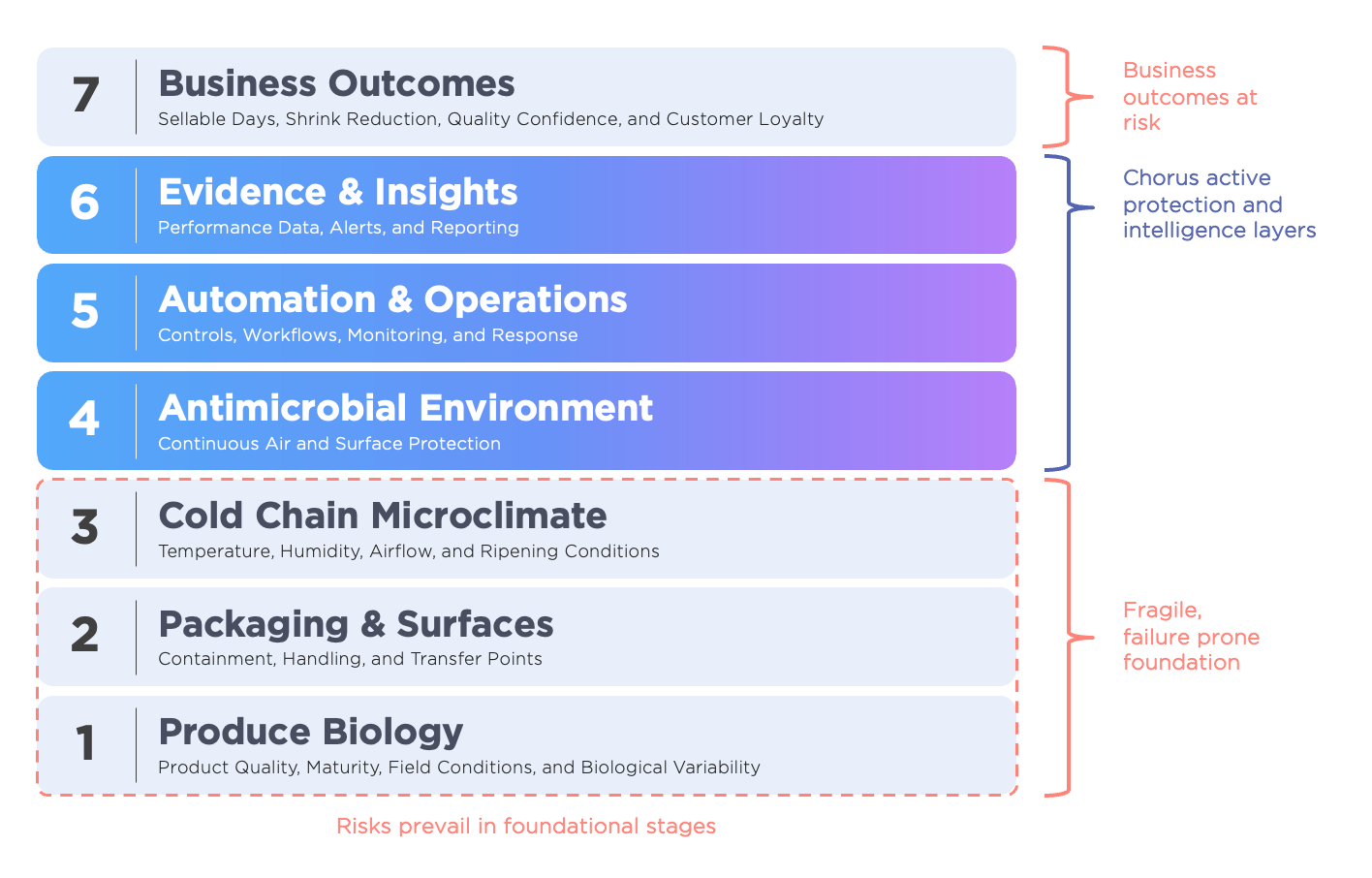
Chorus' Shelf-Life Stack™ is a seven-layer framework for understanding the factors that collectively influence shelf-life predictability.
- Produce Biology - Starting quality, maturity, field conditions, commodity differences, and natural biological variability.
- Packaging & Surfaces - Packaging, containment, handling, transfer points, and the surfaces produce encounters throughout its journey.
- Cold Chain Microclimate - Temperature, humidity, airflow, ripening conditions, and other variables within storage and transit environments.
- Antimicrobial Environment - The microbial conditions surrounding fresh product and the approaches used to manage them.
- Automation & Operations - The systems, workflows, and automated responses used to manage operating conditions.
- Evidence & Insights - Monitoring, data, and visibility that help operators understand what is happening and respond accordingly.
- Business Outcomes - The downstream results retailers ultimately care about, including sellable days, shrink, quality confidence, and customer loyalty.
The central idea is simple: no single layer determines the final outcome. Shelf-life predictability depends on how the full system performs.
Three parts of the Stack
Layers 1–3 form the foundation. They represent the biological, physical, and cold-chain conditions that fresh produce depends on. These layers are essential, and they are also inherently variable.
Layers 4–6 add active protection and intelligence. They focus on microbial management, system response, automation, and visibility into what is happening inside the environment.
Layer 7 captures the business impact. It is where upstream and operational variables ultimately show up as sellable days, shrink, quality confidence, and customer loyalty.
Chorus' Shelf-Life Stack™ creates a lens for evaluating fresh performance. It moves the conversation beyond individual interventions and toward a more complete question: Where is the system strong, where is it vulnerable, and where can additional control improve predictability?
A new model for shelf-life management
Freshness management has traditionally concentrated heavily on the foundational layers: postharvest practices, packaging, cold-chain execution, and storage conditions.
Those controls remain essential. They are also difficult to manage perfectly across every shipment, facility, transfer point, and operating environment.
Fresh produce is biologically variable. Supply chains involve multiple handoffs. Storage conditions fluctuate. Human and operational variability are part of the system.
Chorus' Shelf-Life Stack™ looks beyond the foundation alone. Layers 4–6 introduce the opportunity for more active, automated, and measurable management downstream, where additional control can help strengthen the overall system.
This is where Digital Microbial Control enters the picture.
Digital Microbial Control is a digitally managed approach to microbial control that combines sensing, automated response, continuous monitoring, and evidence-based visibility. It is designed to move antimicrobial intervention beyond passive or point-in-time treatment.
Within Chorus' Shelf-Life Stack™, Digital Microbial Control provides the architecture for strengthening Layers 4–6 through more active protection, greater automation, and clearer visibility into system performance.
The goal is greater predictability.
Predictability, not perfection
Fresh produce will always be variable. Every commodity, shipment, and operating environment brings a different starting point.
The opportunity is to build a stronger system around that variability.
Chorus' Shelf-Life Stack™ recognizes that losses can accumulate throughout the produce journey and that some variables are outside the retailer's direct control. It also highlights where additional layers of control, intelligence, and visibility can strengthen the system once product reaches downstream environments.
Retailers looking for greater shelf-life predictability should stop searching for a single intervention.
The first step is to think about shelf life differently: as a whole system shaped by interconnected variables, controls, and outcomes.
That is the thinking behind Chorus' Shelf-Life Stack™.